This time, we’re going to focus on whether it’s okay to use present tense in historical writing, which generates a lot of debate and controversy within history writing circles.
Laura recently requested I write about tense, especially in relation to historical writing, and I’m glad she did! It’s a great topic that can be confusing, and there’s a lot of debate in the historical writing community about what tense to use then. It can—dare I say—get tense.
I am going to break my coverage of tense in historical writing into two different posts—one that clarifies when to use past perfect versus past tense (a relatively uncontroversial topic) and another that covers the use of present tense in historical writing (which stirs a lot of debate).
When I asked for suggestions on editing topics to write about, Elise Bishop—my college grammar instructor—suggested I write about passive voice.
As an editor, I do get asked a lot about passive voice. And what I’ve noticed in my years as an editor (and before that as a composition instructor and before that as a writing tutor working for Mrs. B. in a writing center) is that it is often hard for writers to know what passive voice is. They know they’re supposed to avoid it, but how to do so and why are murkier.
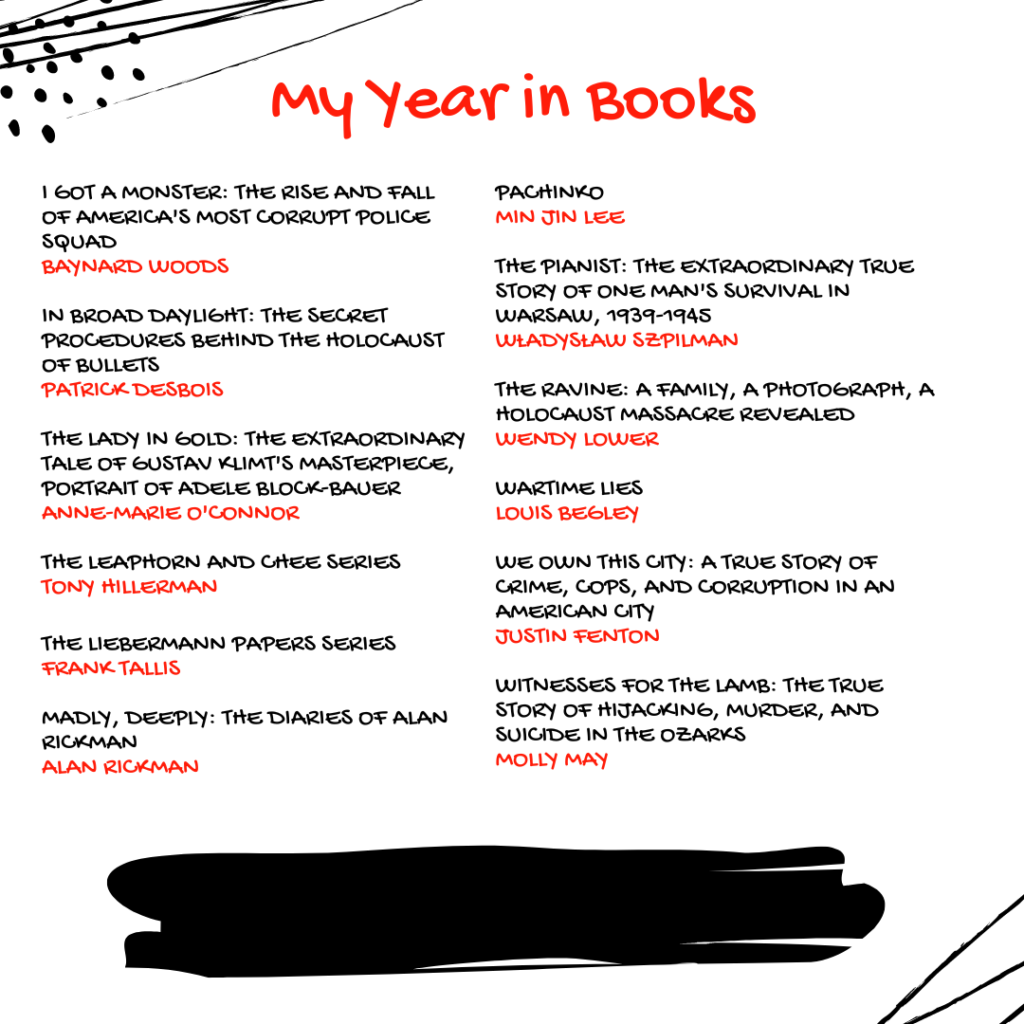
For the past couple of years, I’ve ended the year with a reflection on and recap of my reading over the course of the year, and I wanted to continue the tradition to close out 2022.
I read 53 books for fun in 2022 and another 9 manuscripts, as well as several shorter projects, for work.
I tend to average about 30-40 books a year now–the years of devouring 100+ books a year haven’t happened since I was a teenager–and back in January, I assumed I’d maintain a similar pace for this year. Reading about a book a week was a pleasant surprise and one I’m not opposed to repeating next year if I can.
I tend to delve into deep-dive reading binges when something captures my attention, whether they’re nonfiction subjects or fictional series or multiple works from the same author. This year, I read a lot about topics that I always find myself drawn back to (true crime, World War II, the Holocaust, art history) and explored some new-to-me interests (1960s NASA and mountaineering disaster). I also got back into murder mysteries and enjoyed series that ranged in setting from fin-de-siècle Vienna to modern Quebec to the contemporary American Southwest. I love a good atmospheric mystery!
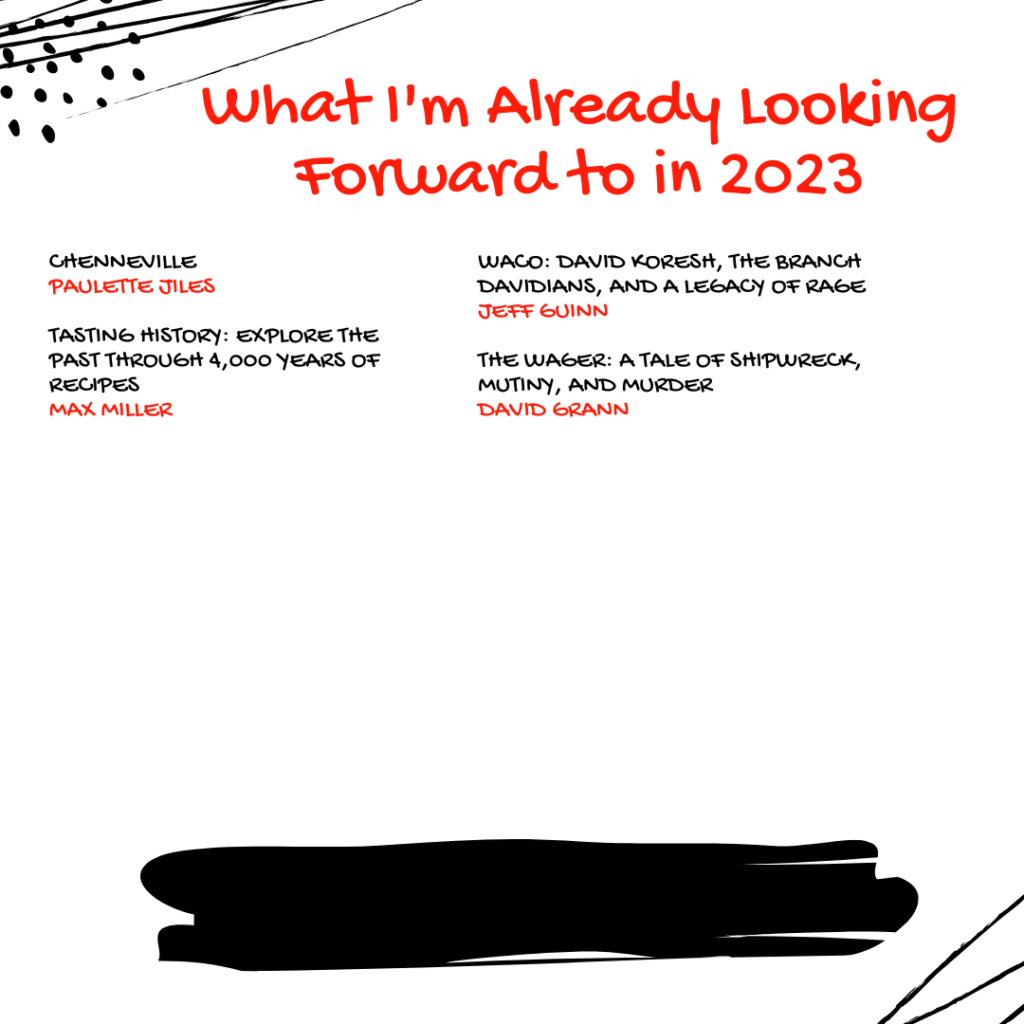
In any event, here are some of the books and series I found especially interesting, enjoyable, excellent, and/or thought-provoking. I also included some of the books I wanted to read and didn’t get around to (story of my life) and a few I’m already looking forward to next year.
What were you reading in 2022? What did you want to read and not get around to this year? What are you already looking forward to next year? Tell me! As you may have noticed, I love to talk about books. 🙂
I wanted to conclude my series on using POV effectively by looking at one of my favorite genres–epistolary fiction.
Epistolary fiction is a story told via letters or other documents. Over the years, authors can and have used everything from diaries to text messages to emails for this genre.
My introduction to epistolary fiction was probably the horror classic Dracula. The story is told through a series of diary entries, letters, newspaper entries, and other documents (including a shipping log). When I was in grad school, I took a class on Gothic novels and their adaptations and ended up spending a few months researching Dracula spinoff/sequel books and how they attempted to establish credibility with readers.
I know any mention of the A Song of Ice and Fire series, its author George R. R. Martin, or its TV adaptation Game of Thrones can lead to some, ahem, passionate debate. And truthfully I’m not particularly interested in most of those debates. I’ve read the books a couple of times and enjoyed them, have my own theories on whether or not Martin will ever finish them, and liked the TV series well enough while also still having my own critiques. What I want to talk about here, though, is Martin’s use of POV, which I find quite well done for the most part. You don’t have to be a fantasy writer to learn some excellent lessons on what to do and what not to do with juggling multiple POVs from these books.
Most people have encountered Ambrose Bierce’s spooky Civil War-set “The Occurrence at Owl Creek Bridge,” likely as part of a short story reading assignment in either high school or college. I certainly read it more than once as an English major, and it is a story that I do enjoy.
It wasn’t until after I graduated that I started reading more of Bierce’s work beyond “Occurrence” and his deliciously snarky Devil’s Dictionary. Bierce ended up writing a lot of fiction about the Civil War (and a fair amount of nonfiction), which makes sense given he’s the only 19th century American writer of note to have served in combat during the war.
Often, point of view (POV) in writing is discussed solely in terms of fiction, implying it’s not relevant for nonfiction writers. That’s simply not true, though. If you’re writing narrative nonfiction, you can use POV to tell the story more effectively. You can generate compelling tension, amplify your themes, and more through artful use of POV in nonfiction. This is particularly true with true crime, history, or historical true crime.
When I was in college, I took a grammar class with Elise Bishop that really changed the way I viewed writing. One particular week of the course looked at how Truman Capote’s In Cold Blood uses a change in verb tense to signal the confession scene.
It’s not uncommon for me to work with authors on point-of-view (POV) problems. There’s a lot of advice out there in writing communities about how to handle POV—how many to have and when and how to switch POV—and some of it is dictated more by personal preference than what actually works for the story.
I’m a big believer in using the POV that is most effective for the story rather than following arbitrary rules on the subject. Still, it’s not uncommon for manuscripts to struggle with how to juggle between POV effectively or to know which POV to use when, which can be a turn-off for readers.
More often than not, when I identify issues with POV in a story, it’s symptomatic of a much more systemic issue of focus that also needs to be addressed. The POV isn’t working because it conflicts with what the story is trying to achieve with its plot, themes, and characters.
As some of you know, I work part time at my local library in addition to running my own editing business. I love my library job and appreciate the fact that, since it is a small rural public library, I often get to do things that would ordinarily be limited to professional librarians with MLS degrees. I do a fair amount of reference work and program development, as well as working the circulation desk, but one of my favorite things to do is readers’ advisory (RA). I’ve long maintained that working at a library makes me a better editor and that working as an editor makes me a better library associate, and RA is one of the reasons I believe this so strongly.
Saying I provide RA services to patrons is a formal way of saying that I’m the person whom people are referred to when they need help finding something new to read. It’s a fun challenge–I’ve handled requests that range from “crime fiction, the gorier to better” to “gritty mysteries with no profanity” to “horror set in insane asylums” to “funny Southern fiction”–and a few weeks ago, I presented a training to my library coworkers on how to offer effective RA services. In the process of working on the presentation, it dawned on me that a lot of this is useful to writers too.